The new ORV Blog has moved!
All the old ORV posts, and new posts can be found on Algalita's website at:
http://www.algalita.org/blog/?cat=6
Wednesday, June 9, 2010


Saturday, May 15, 2010
Nearshore Sampling Aboard ORV Alguita

 May 15, 2010
A warm, overcast sky burns into a gentle breeze and sunshine making for a pleasant day of nearshore sampling aboard ORV Alguita. Our work and enjoyment of the ocean scene along the Long Beach coast is, as usual, too often interrupted with balloons. We follow a bundle of silver hearts and an inflated #1 as it drifts out of reach over the water. Facundo skillfully hooks the bundle just after it settles on the ocean surface. Closer inspection reveals this pollution was generated in celebration of a little girls first birthday. Another colorful bundle of balloons reads "Caring with a personal touch".

 Thankfully our first otter trawl yields more fish than plastic (on the left Captain Moore pours the tub of specimens into a tank for further inspection). Later in the lab we will see if these fish have been including plastic in their diet. Above research crew member, Christiana, holds up a bit of plastic she untangled from the net along with these fish.
Above, our second otter trawl yields a familiar reminder of the confusion marine organisms can have when deciphering between plastic and prey (the infamous visual similarity between sea jellies and clear plastic).
 We draw a second, less common comparison between a fragment of a moon snail egg collar (on the left above) and the fragment of plastic.
 We also sampled the surface water just inside the break wall of the Long Beach Harbor using a manta trawl (above). On the left, Christiana and Emily are rinsing the sample from the cod end of the net into a bowl. Unfortunately, even a quick inspection of this sample reveals that it is largely composed of plastic. Christiana points out some of the smaller fragments floating in the collection bowl beside a plastic bag.
Sunday, February 14, 2010
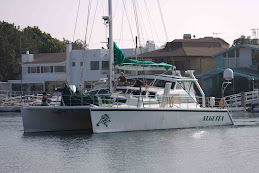
 Hello from aboard ORV Alguita in the Pacific Ocean! ORV stands for Oceanographic Research Vessel, and Alguita is the research vessel that has carried our research team to the most remote regions of the Pacific Ocean to study plastic pollution. Many of you have joined us on these voyages so I thought you would be interested to see what Alguita and crew are up to now.
 There are over 4,000 miles of Ocean and North American Continent between us and the crew aboard Sea Dragon- but we are working together to answer many of the same questions about plastic pollution. Today our job aboard ORV Alguita is to investigate the connection between plastic pollution entering the ocean through our watershed and the marine food web in Southern California. We also had the opportunity to head a little way offshore to observe some of the debris flushed out to sea by the recent storms. (The pic to the left shows some of what we found.)
 Marcus and Anna have explained that most of the plastic pollution that they are finding in remote areas of the ocean found its way into the ocean through watersheds. Plastic litter on land flows directly out to sea when it rains. Today we traveled to the mouths of three major rivers here in Southern California: The Los Angeles, San Gabriel and Santa Ana Rivers to see if the large quantities of plastics entering the oceans at the river mouths are also entering the food chain through the mouths of fish. (The pic to the left is of the mouth of the Santa Ana River.)
 To find out if the fish at the river mouths have been eating the plastic debris as it flushes out to sea, the crew used an otter trawl to collect fish from the ocean floor. Here the crew is pulling in the net to see what they have caught. For those of you who have joined on past voyages you may recognize Captain Moore, Christiana (our ichthyologist) and Jeff- Facundo also joined in and helped everything run smoothly. Below on the left Christiana shows us two queenfish that she collected in the trawl. Unfortunately a few of the trawls contained almost as much plastic pollution as they did fish. On the right is an anchovy she caught in the trawl along with the plastic top of a soda cup, a piece of plastic packaging, and a black trash bag. The fish will be taken back to the laboratory where Gwen and Christiana will examine the contents of their stomachs.

 Today we also had the opportunity to head a bit farther offshore to see how much plastic pollution the recent storms washed out to sea. It was very disappointing to find windrows thick with plastic pollution outside the harbor in the open ocean. We stopped briefly to scoop up what we could. It is interesting to see how similar plastic items congregate in the same location. We found one section of a windrow that was dominated by plastic straws of every color, shape and size- a "strawrow". Some are striped with a bend, others have spoons on one end for digging through a slurpee. As the straws bob amid loose bits of seaweed they look like the branching canopy of some mysterious underwater plastic forest.

A cormorant surfaces through the "strawrow" adorned with a clear straw- the reality of how we have littered this marine organism's home suddenly strikes deep. The straws are difficult to catch because they slip through the mesh of our nets- but after a few moments we already have a collection of 32 straws. Nearby we find a section of the windrow where plastic bottle caps have gathered.

Unfortunately today we were also reminded of how directly plastic pollution can harm wildlife. Several California sea lions were sunbathing on a buoy. As we passed by them Captain Moore noticed that one had plastic fishing line wrapped around her neck- a potentially deadly necklace. It was frustrating that we could do nothing for her- she is still strong and if we had approached her she would have slipped into the water and swam away. All I could do was take pictures and ask all of you to be very careful with your fishing line if you go fishing.

 The variety of plastic pollution we encountered today was bewildering, but the strangest item was a balloon. Balloons unfortunately are an extremely common sight on the water, many people throw parties and release their balloons into the air (though I know none of you would do this). We saw balloons of all shapes and colors today but this one was different. We could see this bright pink balloon from quite a distance, when we got closer Captain Moore skillfully captured it with the boat hook. Pink, shiny and adorned with a picture of Hanna Montana the balloon read "Lets Rock." And sure enough hitting the balloon with the boat hook caused it to launch into song from a small speaker embedded inside.
 For me, the day provided a continually changing perspective on our local marine ecosystems. Dolphins joined us to play in front of our bow, pelicans and terns dove from the air catching fish around the research vessel, harbor seals and sea lions basked in the sun barely opening their eyes as we passed- the diversity of marine life in this area is amazing! Similarly to Marcus and Anna's experience in the Atlantic, as we passed through windrows of plastic litter suddenly the serene ocean scene would give way to an uncomfortable reminder of our impacts on the ocean and how much work we have ahead of us.
Thank you all for joining us -Holly-

Wednesday, February 3, 2010
Sunday, January 10, 2010
Captain Moore Gains Media Coverage while Lecturing on the East Coast

Captain Moore spoke on Maine's Public Radio this week after being on Colbert Nation Tuesday 1/6/10 and presenting at the MERI Ocean Environment Lecture Series in Maine on 1/8/10.
The Captain has a full dance card while traveling up and down the east coast lecturing. He will be at it again on 1/11 at the Beacon Academy Lecture Series. On January 12th, he will present at the Marine Science Center at Northeastern University Nahant, Massachusetts. Last, but not least, the Captain will be at UNCWilmington presenting in the Lumina Theatre, Student Fisher Center on the university campus. A scientific poster session will pregame his lecture. All are free and open to the public so go and find yourself a seat!
If you can't make it, you could go to 5gyres.org and learn more about this issue. It's Algalita and Marcus Erikson's latest initiative. It's loaded with info and is a very cool site. Marcus and Anna - you rock!
Captain Moore Entertains While Schools Colbert on Plastic Pollution
Captain Charlie Moore defended our oceans on Comedy Central and won. Great job Charlie. Thank you Stephen Colbert for letting Charlie loose!
| The Colbert Report | Mon - Thurs 11:30pm / 10:30c | |||
| Charles Moore | ||||
| ||||
Wednesday, October 7, 2009
The Warm Welcome Home
 Thank you Algalita and friends for the warm welcome home. Marieta Francis and Jeanne Gallagher - you two were a sight for sore eyes. Along with many others including Jeff's parents, Kent and Kathy Ernst.
The last few miles in, I sat on the bow ready to video any sea lions or dolphins sightings so I could send a picture back to Vicki Rivenbark's class at Holly Tree School back in Wilmington, NC. The only thing we saw as we neared Alamitos Bay was plastic trash making its way out to sea as we headed in. Things like Styrofoam  containers, chip bags, bottles, and even a soccerball accompanied by a bottle. But the most disturbing was actually witnessing a seagull pecking at a floating plastic bag. "It looked like we were back in the gyre." Lindsey turned to me and said, "This is where it all starts." Thank goodness the Algalita supporters where out there to distract us. It was all too
  overwhelming to see so much trash in its origin- from land. It played out like a scene in "The Twilight Zone." I, personally, felt like our trip out into the gyre was some kind of victory, only to return to business as usual. The j
 aded twist to the end of our journey.
 containers, chip bags, bottles, and even a soccerball accompanied by a bottle. But the most disturbing was actually witnessing a seagull pecking at a floating plastic bag. "It looked like we were back in the gyre." Lindsey turned to me and said, "This is where it all starts." Thank goodness the Algalita supporters where out there to distract us. It was all too
  overwhelming to see so much trash in its origin- from land. It played out like a scene in "The Twilight Zone." I, personally, felt like our trip out into the gyre was some kind of victory, only to return to business as usual. The j
 aded twist to the end of our journey.
 It's going to take a lot more people, like Marieta, willing to lend a hand not letting plastic pollution go out to sea.

I do have a better ending to our last night together though. We left Avalon early Tuesday morning after a dinner the night before at the The Lobster Pot. The waiter asked us where we would like to sit and Lindsey, spying a table for six elevated by a handful of steps into the back of a sawed off boat, said "How about there?" We all looked at the stern nestled up against the wall, shrugged, and climbed the stairs. Why not, what was one more meal elbow to elbow enclosed by the sides of a boat.
Bonnie Monteleone over and out
Subscribe to:
Posts (Atom)